


Can a Commercial RO Membrane be used for seawater desalination?
Sep 18, 2025
Leave a message
Hey there! As a supplier of commercial RO membranes, I often get asked if our commercial RO membranes can be used for seawater desalination. It's a question that touches on a crucial and interesting aspect of water treatment. So, let's dive right in and explore this topic together.
First off, let's understand what a commercial RO membrane is. Commercial RO membranes are designed for various industrial and commercial applications. They're built to handle different levels of water salinity and contaminants. These membranes are used in settings like restaurants, small - scale industries, and commercial buildings to purify water. For instance, we have products like the Residential RO Membrane 3012 which, although named residential, also has applications in small - scale commercial settings. It's a reliable membrane that's popular for its efficiency in removing common impurities from water.
Now, seawater desalination is a whole different ballgame. Seawater has an extremely high salt content, typically around 3.5% (35,000 ppm). This is much higher than the water sources that commercial RO membranes usually deal with. When we talk about desalinating seawater, the main goal is to remove a large amount of salt and other dissolved solids to make the water suitable for drinking, irrigation, or industrial use.
Commercial RO membranes are engineered with specific pore sizes and rejection rates. Their pore sizes are designed to block a wide range of contaminants, but when it comes to seawater, the high salt concentration poses a significant challenge. The osmotic pressure of seawater is very high. Osmotic pressure is the force that needs to be overcome to push water through the RO membrane. With seawater, this pressure can be as high as 28 - 35 bar (400 - 500 psi). Most commercial RO membranes are rated for lower operating pressures, usually in the range of 15 - 25 bar (220 - 360 psi). If we try to use a commercial RO membrane for seawater desalination at the high pressures required, it can lead to membrane damage. The membrane may rupture or develop leaks, which will reduce its efficiency and lifespan.
Another important factor is the rejection rate. A good RO membrane should have a high rejection rate for salts and other contaminants. For seawater desalination, we need a membrane that can reject over 99% of the salts. While commercial RO membranes can achieve high rejection rates for common water sources, they may not be able to reach the level required for seawater. For example, our Domestic Reverse Osmosis Membrane is great for treating tap water or slightly brackish water, but when it comes to seawater, its rejection capabilities may fall short.

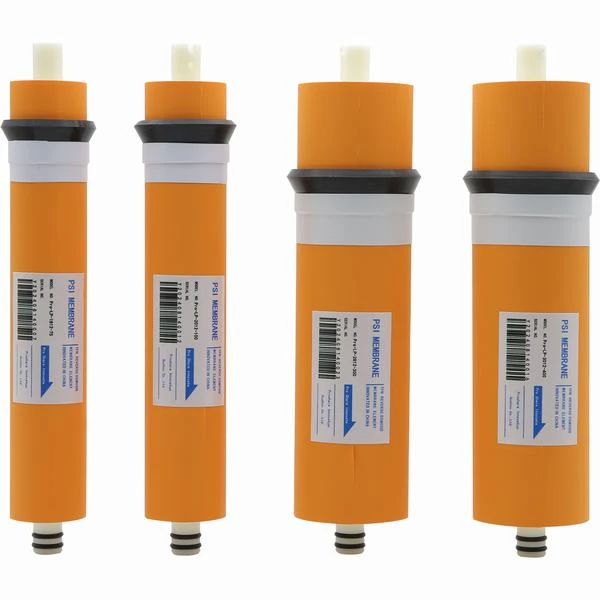
However, that doesn't mean commercial RO membranes have no place in seawater desalination projects. In some cases, they can be used in a pre - treatment stage. Seawater desalination plants often have multiple stages of treatment. The first stage might involve using commercial RO membranes to remove some of the larger particles and a portion of the salts. This can help reduce the load on the more specialized seawater RO membranes that are used in the main desalination process. By doing this, we can extend the lifespan of the more expensive seawater - specific membranes and improve the overall efficiency of the desalination plant.
Let's also consider the cost. Commercial RO membranes are generally more affordable compared to seawater - specific RO membranes. If we can use them effectively in the pre - treatment stage, it can significantly reduce the overall cost of the desalination project. For a small - scale seawater desalination initiative or a project with a limited budget, using commercial RO membranes as part of the pre - treatment can be a practical solution.
But we need to be careful. If we use commercial RO membranes for seawater desalination without proper pre - treatment and without considering the operating conditions, we'll face some problems. The high salt content can cause scaling on the membrane surface. Scaling occurs when salts and other minerals precipitate out of the water and form a hard layer on the membrane. This can block the pores of the membrane, reducing its water - flow rate and performance. It can also increase the energy consumption of the system as more pressure is needed to force water through the scaled - up membrane.
In addition to scaling, the high salt concentration can also cause corrosion. Seawater contains various corrosive elements like chloride ions. These ions can attack the membrane material and the other components of the RO system, leading to premature failure of the equipment.
So, in conclusion, while a commercial RO membrane isn't typically designed for direct seawater desalination, it can play a role in the overall process as a pre - treatment option. If you're thinking about a seawater desalination project, it's important to consult with experts. They can help you design a system that uses commercial RO membranes effectively, along with other components like proper pre - treatment filters and the right seawater - specific RO membranes.
If you're interested in learning more about our commercial RO membranes, whether for pre - treatment in seawater desalination or for other commercial applications, we'd love to hear from you. Our team of experts can provide you with all the information you need and help you choose the right membrane for your specific needs. Just reach out, and let's start a conversation about how we can work together to solve your water - treatment challenges.
References
- "Reverse Osmosis Technology: Principles and Applications" - A comprehensive book on RO technology that explains the differences between membranes for different water sources.
- Industry reports on water desalination, which provide data on the performance of different types of RO membranes in seawater desalination projects.
Send Inquiry